

Your cat or dog does not need a perfect full-mouth scrub tonight. The win is a calm mouth-touch routine that can become daily brushing, because brushing is the home dental habit veterinary dental groups most consistently recommend for plaque control in cats and dogs (AVDC, WSAVA).
Brushing is comfort care, not vanity grooming
Dental disease is not a cosmetic problem. Plaque and gingivitis can progress into painful periodontal disease, infection, tooth loss, and poorer quality of life in dogs and cats (VCA, International Cat Care).
That is the frame that helps the habit stick. You are not trying to give Mochi the Persian a showroom smile. You are trying to notice sore gums earlier, reduce plaque pressure at home, and make the next vet dental conversation less of a surprise.
Use this guide to prepare for that conversation, not to diagnose your pet at home.
The first mistake is usually ambition. An owner buys a tiny toothbrush, opens the pet’s mouth wide, meets claws or panic, and quietly quits by the second week. A better start is smaller: lips today, gums later, brush after that.
| Goal | Better first step | Skip for now |
|---|---|---|
| Cat accepts mouth handling | Touch the lip, reward calm behaviour | Forcing the mouth open |
| Dog accepts the brush | Let the dog sniff and taste pet toothpaste | One long scrubbing session |
| Owner builds consistency | Keep brush, paste, and reward together | Hunting for supplies each night |
| Plaque control improves | Work toward daily brushing | Treating chews as equal replacements |
Start with tolerance, especially for cats
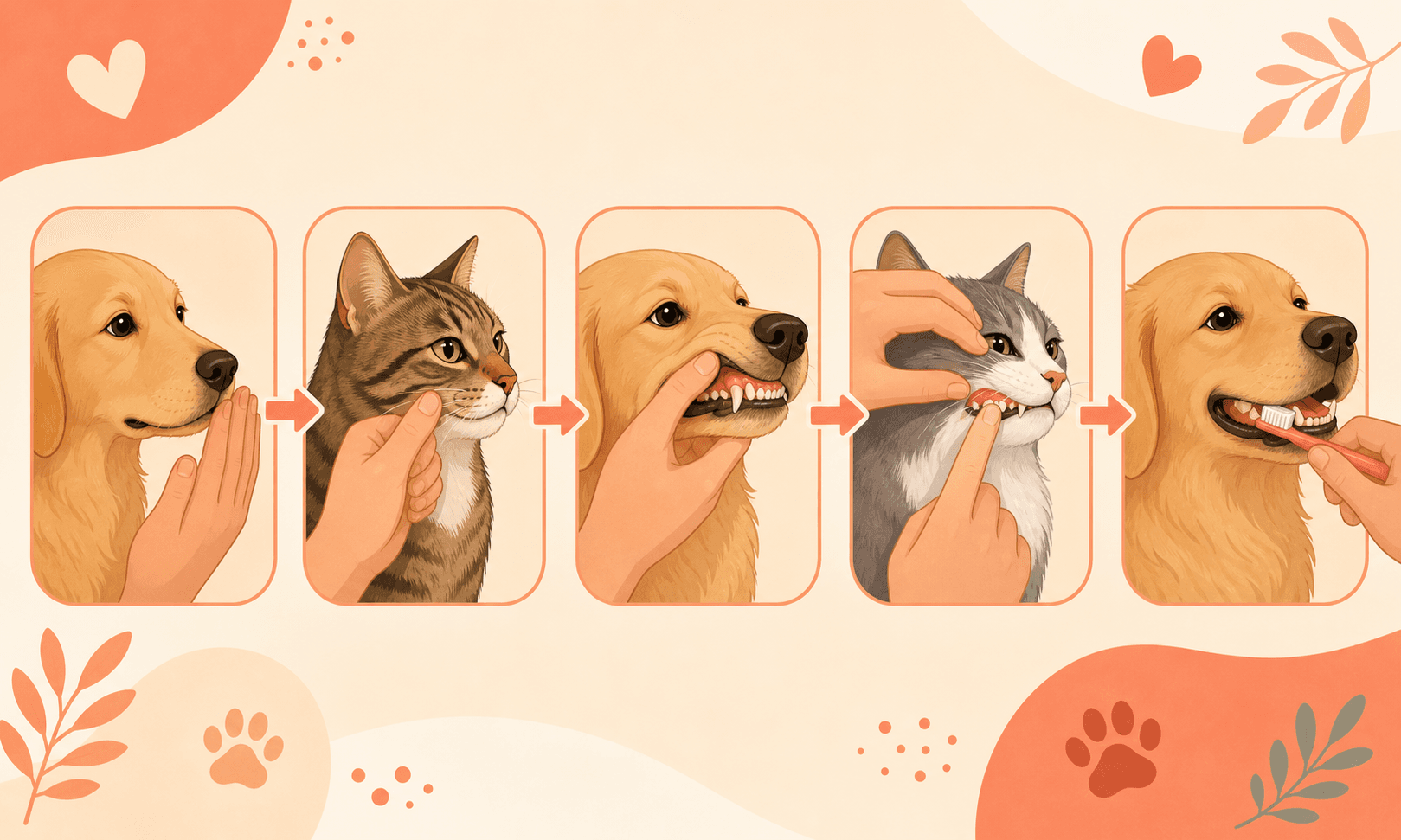
For cats, the first win is not brushing every tooth. It is tolerance.
International Cat Care recommends gradual introduction, positive reinforcement, and simple mouth handling before moving to brushing (International Cat Care). That matters for cats like Luna, a nervous domestic shorthair who already dislikes nail trims. If brushing begins as restraint, she learns the bathroom is a trap.
Start where your cat can still succeed. Touch the side of the lip. Stop. Reward calm behaviour. Later, lift the lip briefly. Later again, touch the gum with a finger. A finger brush or small pet toothbrush can come after the mouth is no longer a drama.
Keep the routine boring. Same room. Same calm voice. Same reward. The point is not to win a contest with your cat. The point is to make mouth handling ordinary.
| Cat step | What success looks like |
|---|---|
| Lip touch | Cat stays near you after the touch |
| Lip lift | Cat allows a brief look without panic |
| Gum touch | Cat accepts a finger near the gumline |
| Finger brush or small brush | Cat allows a few outer tooth surfaces |
| Repeat routine | Cat recovers quickly and returns for the reward |
If your cat pulls away, reduce the ask. Partial cooperation still counts. The ASPCA’s guidance on desensitisation and counterconditioning supports gradual exposure paired with positive association, rather than flooding the animal with the full task at once (ASPCA).
Dogs usually do better with short, positive sessions
Dogs often accept brushing faster than cats, but they can still learn to hate it if the session becomes a wrestling match.
For dogs, veterinary owner guidance commonly recommends introducing the toothbrush in steps, using canine toothpaste, rewarding cooperation, and focusing on the outer tooth surfaces where plaque collects (AKC). That is useful for a Cavapoo, a Singapore Special, or an older Shih Tzu with a small mouth and strong opinions.
Let the dog investigate the brush. Let him taste the pet toothpaste. Touch one side of the mouth. Reward. Stop while he is still cooperating. Tomorrow, ask for a little more.
This is where owners need discipline. The moment the dog behaves well, the human wants to “finish the job”. That can undo the trust. Quit early enough that your dog still thinks the routine is worth showing up for.
Focus on the outside surfaces first. They are more accessible, and owner guidance commonly points there as the workable starting area. If your dog clamps down, paws at the mouth, or backs away, return to lip handling and toothpaste tasting.
Use pet-safe toothpaste and treat add-ons as backup
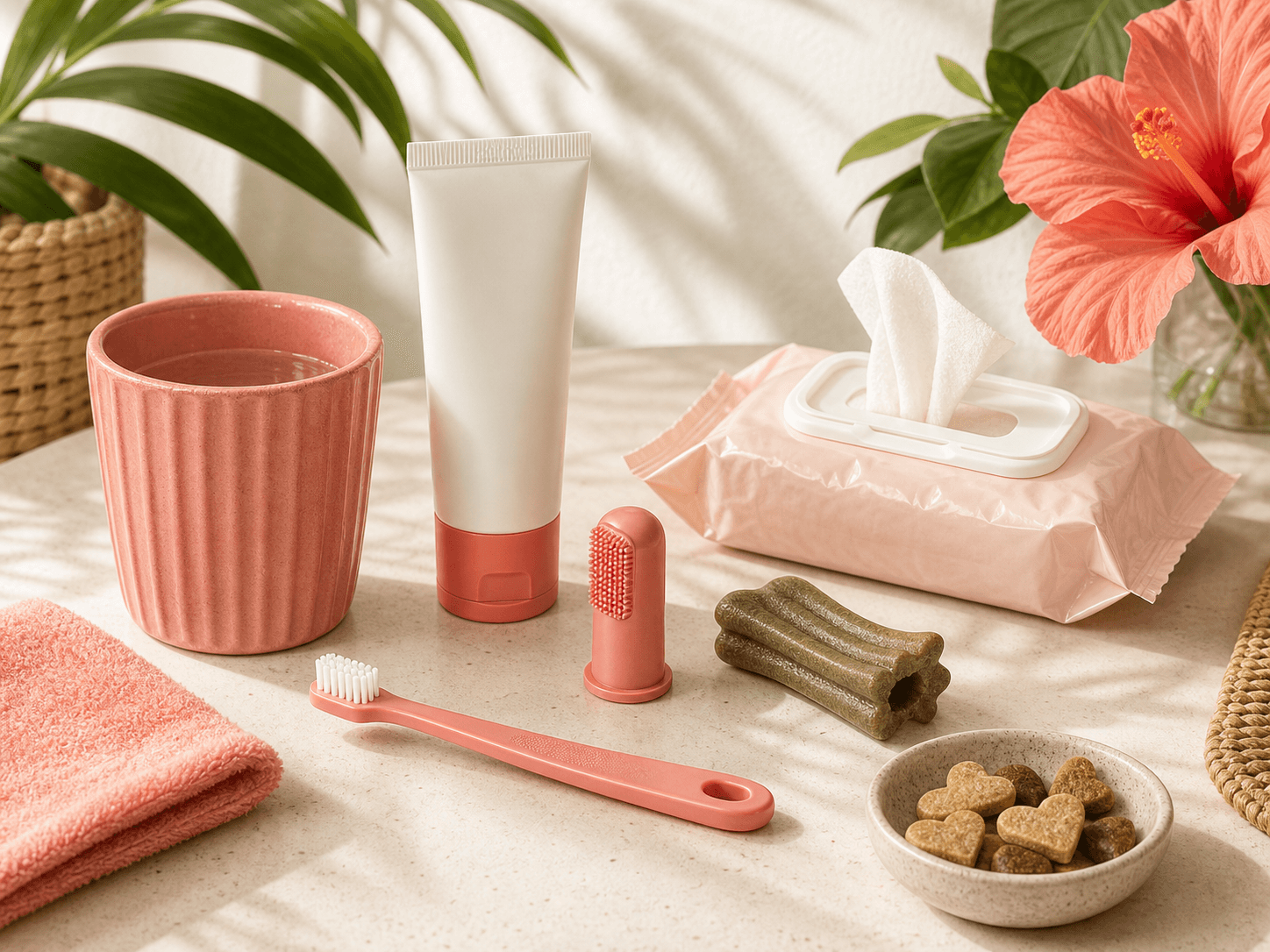
Human toothpaste is for humans. Cats and dogs swallow toothpaste during brushing, so use products made for pets. Human oral-care products may contain ingredients such as fluoride, foaming agents, or xylitol that are unsafe when swallowed; xylitol is listed by ASPCA as toxic to dogs and can appear in oral-care items (ASPCA). Merck also notes that pet toothpaste is formulated to be swallowed (Merck Veterinary Manual).
Dental chews, diets, water additives, and wipes can be useful backups. They are not the same as brushing. If you use them, look for products accepted by the Veterinary Oral Health Council, which lists products that have met its standards for plaque control, tartar control, or both (VOHC). Cornell’s feline guidance also treats other dental products as adjuncts, not replacements for brushing (Cornell Feline Health Center).
| Tool | Use it for | Keep in mind |
|---|---|---|
| Pet toothbrush | Main brushing routine | Introduce gradually |
| Pet toothpaste | Makes brushing safer and more acceptable | Do not swap with human toothpaste |
| Dental chew | Backup plaque or tartar support | Check VOHC acceptance where possible |
| Water additive | Extra support for some pets | Not equal to brushing |
| Dental wipe | Handling practice or light cleaning support | Still not a full brush substitute |
In Singapore flats, the practical barrier is often not space. It is routine. Dense urban pet care still depends on daily handling, welfare, and veterinary attention, as NParks AVS frames owner responsibility (NParks AVS). Attach brushing to something that already happens: evening feeding, grooming, or the last toilet walk.
In Malaysia and Indonesia, heat and humidity make storage hygiene worth noticing. Malaysia’s official climate information describes a hot, humid equatorial climate, and Indonesia’s BMKG provides tropical climate information for the country (Malaysian Meteorological Department, BMKG). Let brushes dry between uses, store tools cleanly, and replace contaminated tools after oral infection or illness, following the same hygiene logic WHO gives for preventing microbial contamination in warm environments (WHO).
Stop brushing and book a dental check when signs show up
Brushing should not be painful. If the brush reveals a problem, stop trying to push through.
The AVMA lists warning signs of pet dental problems including bad breath, broken or loose teeth, abnormal chewing, drooling, swelling, bleeding, and reduced appetite (AVMA). For owners, this is the point where home care pauses and a veterinary dental check becomes the next step.
| What you see | What to do |
|---|---|
| Mild resistance, no pain signs | Go back one training step |
| Bleeding gums | Stop and book a dental check |
| Loose or broken tooth | Stop and book a dental check |
| Facial swelling or mouth pain | Book a dental check promptly |
| Drooling, pawing, or food refusal | Stop brushing and call your vet |
| Bad breath that persists | Book a dental check |
What changed and why: older home advice often made brushing sound like a grooming chore. Better framing treats it as comfort care plus early detection. Cosmetic scraping alone is not a substitute for professional dental care, because meaningful cleaning below the gumline requires veterinary assessment and, when needed, anaesthesia (AAHA, Royal Veterinary College).
Tonight, put the pet toothbrush, pet toothpaste, and reward in one place. Touch one lip calmly. Stop there if that is all your cat or dog gives you. Small thing, done daily.
— Manja