

A new tank can look clean while the water is already hard on your fish. Test the water, feed lightly, and pause new fish until the filter has caught up.
New tanks fail quietly before they look dirty
The first problem in many new aquariums is not the glass, the gravel, or the decoration. It is invisible waste.
Fish waste and uneaten food produce ammonia. In a mature aquarium, nitrifying bacteria help convert ammonia to nitrite, then nitrate. That is the nitrogen cycle. In a new aquarium, that bacterial system is still building, so ammonia can appear before the biological filter is ready to process it.
There is no "low but acceptable" reading for the two toxic forms. The targets recognised by animal-welfare and fishkeeping authorities are strict: ammonia 0 ppm and nitrite 0 ppm. The RSPCA notes ammonia is toxic to fish at 0.1 ppm — one part in ten million — and that the tank is only "fully cycled" once nitrate is being produced while ammonia and nitrite both read zero, which usually takes 4 to 6 weeks. Nitrate, the end product, is far less toxic but should not be allowed to climb without limit: aquatic water-quality references treat levels above 50 ppm as undesirable in freshwater aquaria, and a routine partial water change of about 10% per week keeps it in range.
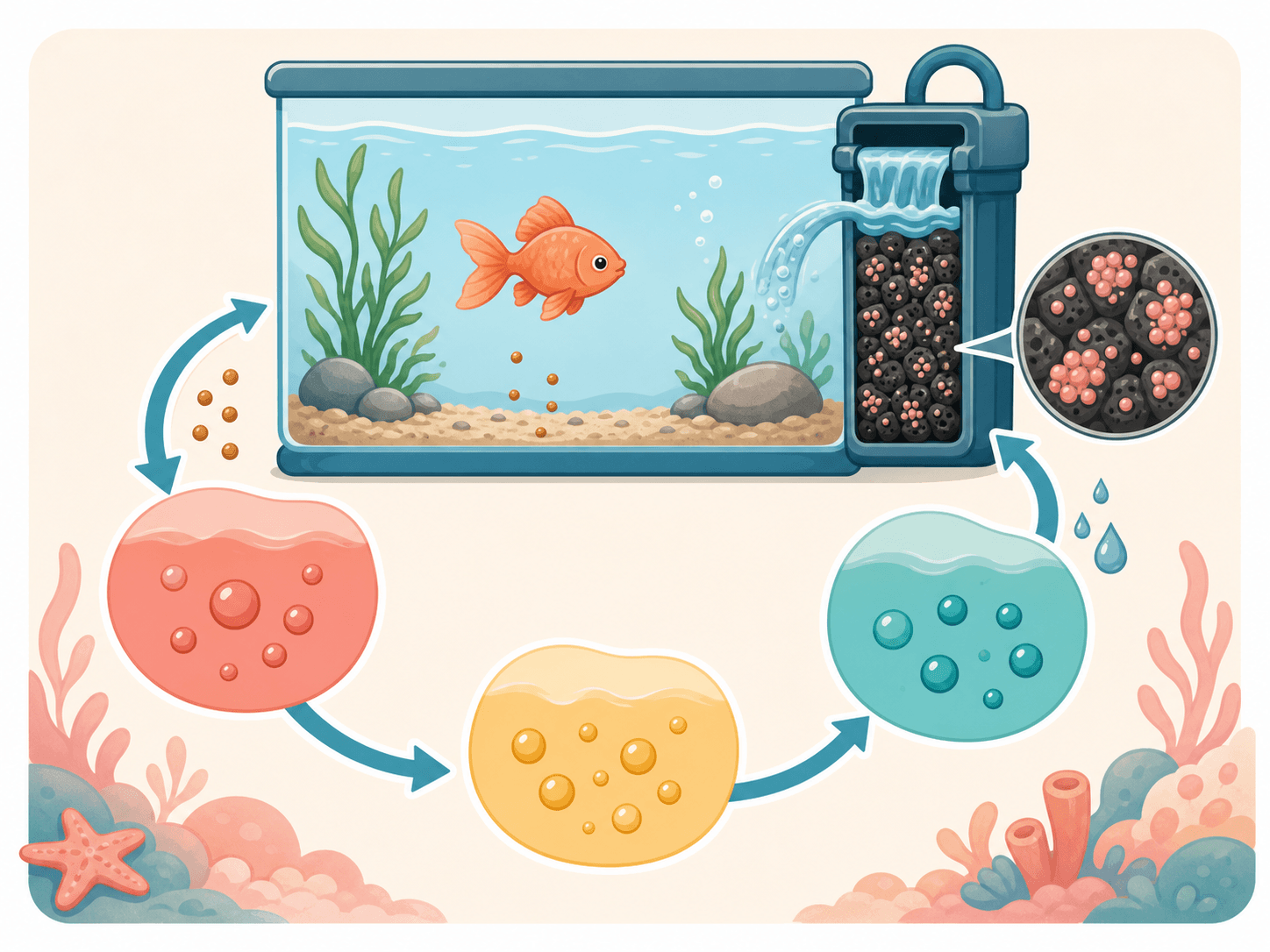
This is why a new tank may look fine on Monday and have fish gasping by Wednesday. Clear water is not proof of safe water chemistry. A liquid test kit is more useful than guessing from smell, cloudiness, or whether the tank looks “fresh”. While the tank is still cycling, the RSPCA recommends testing ammonia and nitrite every two to three days for the first six weeks.
Use this guide to prepare for better fish care, not to diagnose every sick fish at home.
| Reading | Target | Why it matters |
|---|---|---|
| Ammonia | 0 ppm | Toxic to fish from about 0.1 ppm (RSPCA) |
| Nitrite | 0 ppm | The only safe nitrite level is zero |
| Nitrate | below 50 ppm | Far less toxic, but stresses fish as it climbs; ~10%/week water change holds it down |
| Cycle status | nitrate rising, ammonia + nitrite at 0 | Tank "fully cycled", usually after 4 to 6 weeks |
Warm rooms make ammonia more urgent
Singapore, Malaysia, and Indonesia owners often keep tanks in warm indoor rooms. That matters.
Ammonia in water splits into two forms, and only the un-ionised form is highly toxic to fish — harm to sensitive fish can begin from around 0.05 mg/L of un-ionised ammonia. The share that sits in this toxic form rises as pH and temperature rise. The jump with pH is steep: at the same total ammonia and temperature (26°C), a tank at pH 8.0 holds almost ten times more toxic ammonia than one at pH 7.0 — about 5.7% of the total versus about 0.6%. Warmer water pushes the same way. Tropical tanks may already run warm, even before you add lights, pumps, or a sunny room, which leaves a high-pH, warm tank with little margin.
This does not mean every warm tank is unsafe. It means warm homes leave less room for sloppy cycling. A small tank in a hot room, stocked quickly, and fed generously is a common setup for a bad first month.
Aeration and filtration matter too. Fish and filter bacteria both depend on oxygenated water. A filter switched off overnight, or a power outage during cycling, can make water-quality problems worse. In a new tank, the filter is not decoration. It is life support for the biological filter you are trying to grow.
| Beginner habit | Safer routine |
|---|---|
| Put the tank near strong sun | Keep temperature more stable where possible |
| Switch the filter off at night | Keep filtration running so bacteria and fish have oxygenated water |
| Add many fish at once | Add fish a few at a time so filtration bacteria can adapt (RSPCA) |
| Trust clear water | Test ammonia and nitrite instead of guessing |
Warning signs show up in the fish first
Fish often tell you the water is wrong before the tank tells your eyes.
Watch for gasping at the surface, lethargy, clamped fins, red or inflamed gills, loss of appetite, unusual hiding, or sudden deaths. These signs can fit ammonia or nitrite trouble, especially in a new aquarium.
Do not wait for every fish to show the same sign. One guppy hanging at the surface while the others look quieter than usual is already a reason to test. A betta that stops eating and clamps its fins is not being dramatic. A school of tetras suddenly hiding after a feeding mistake deserves the same attention.
The practical move is simple: test the water before buying medicine, more fish, or a second bottle of bacteria product. Many beginner tanks do not need more products first. They need less waste, cleaner water, and time for the biological filter to mature.
| What you see | What to do first |
|---|---|
| Fish gasping at the surface | Test water and check filtration and aeration |
| Red or inflamed gills | Treat water quality as urgent |
| Clamped fins or lethargy | Test before assuming a random disease |
| Sudden loss of appetite | Check recent feeding and water quality |
| Sudden deaths | Stop adding fish and investigate ammonia or nitrite trouble |
What changed (and why)
Older beginner advice often made the tank look like the main project: wash the gravel, arrange the plants, let the water clear, then add fish. The better lesson is less glamorous. The filter’s bacteria are the project.
A new tank should not be stocked heavily at once. Beneficial bacteria need time to grow, and waste spikes happen when fish load rises faster than the biological filter can process it. The RSPCA puts the rule plainly: do not add large numbers of fish at any one time, because gradual introduction lets the filtration bacteria slowly adapt. Adding just a few fish at a time reduces the chance of ammonia and nitrite trouble while the bacteria population catches up.
Feeding also needs a reset. Overfeeding is a common trigger for new-tank ammonia spikes because uneaten food decomposes into nitrogen waste. During cycling, feeding less reduces the load on the system. Your fish still need food, but the tank does not need a generous buffet while its filter is immature.
Filter cleaning has changed for many beginners too. If the media looks dirty, the instinct is to rinse it under the tap until it looks clean. Usually, that is the wrong instinct. Filter media should be rinsed in removed tank water rather than untreated tap water, because preserving beneficial bacteria is central to maintaining the biological filter.
First response when the test looks bad
If ammonia or nitrite reads above 0 ppm, partial water changes are a practical emergency response — the RSPCA suggests partial changes of about 10 to 25% of the tank water. Replacement water must be dechlorinated before it goes into the aquarium, because chlorine or chloramine can harm fish and filter bacteria.
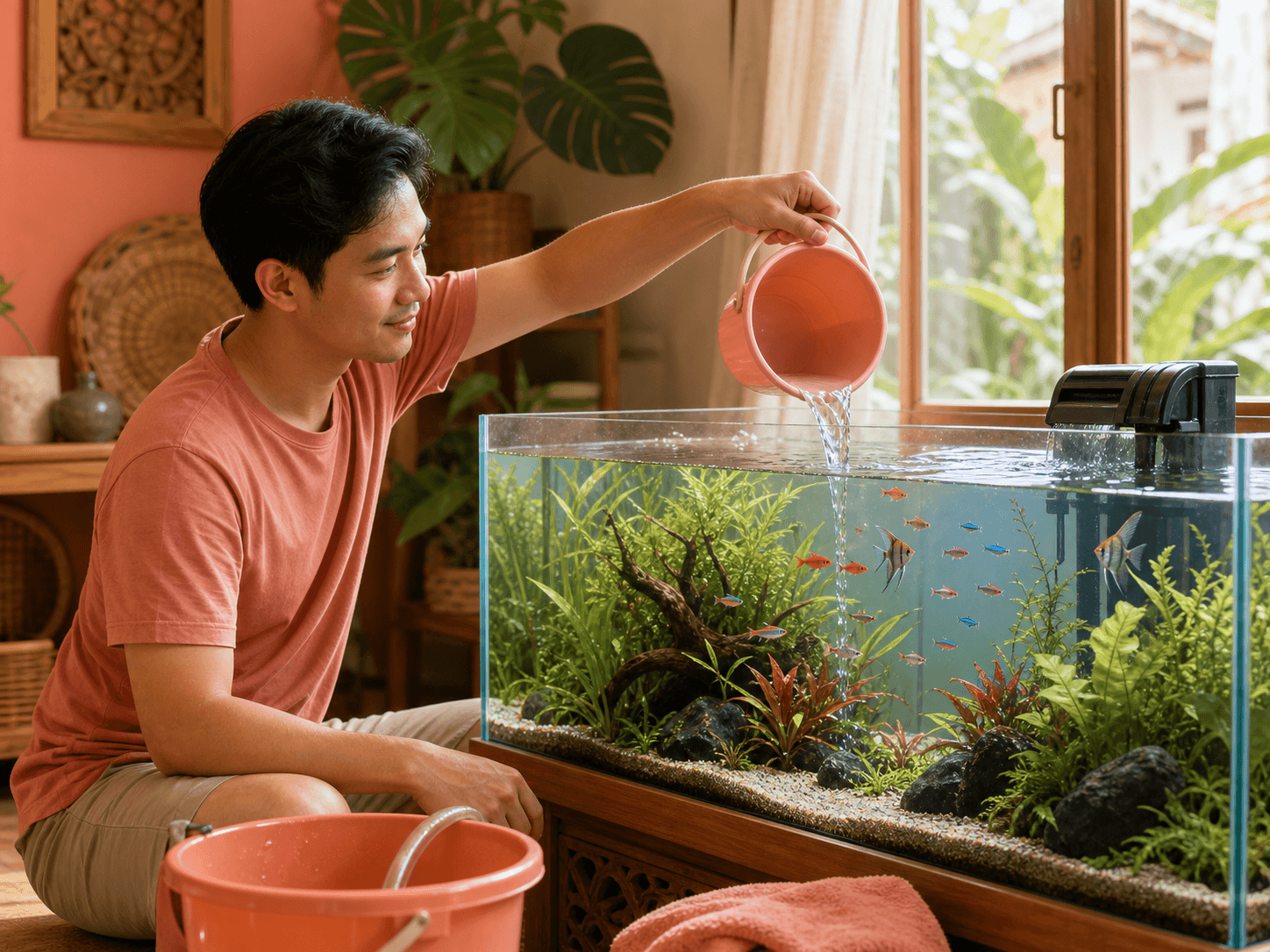
Do not add untreated tap water and hope the filter will handle it. Municipal tap water can contain disinfectants, and aquarium bacteria are part of what you are trying to protect. Treat the replacement water first.
Then reduce the load. Feed less during cycling. Stop adding fish. Remove obvious uneaten food or decaying organic matter. Keep the filter running. If the fish are already gasping, hiding unusually, refusing food, or showing red gills, treat the situation as a water-quality problem until testing proves otherwise.
The small thing to do tonight: test the water, feed lightly, and make sure the filter stays on before you buy another fish.
— Manja