
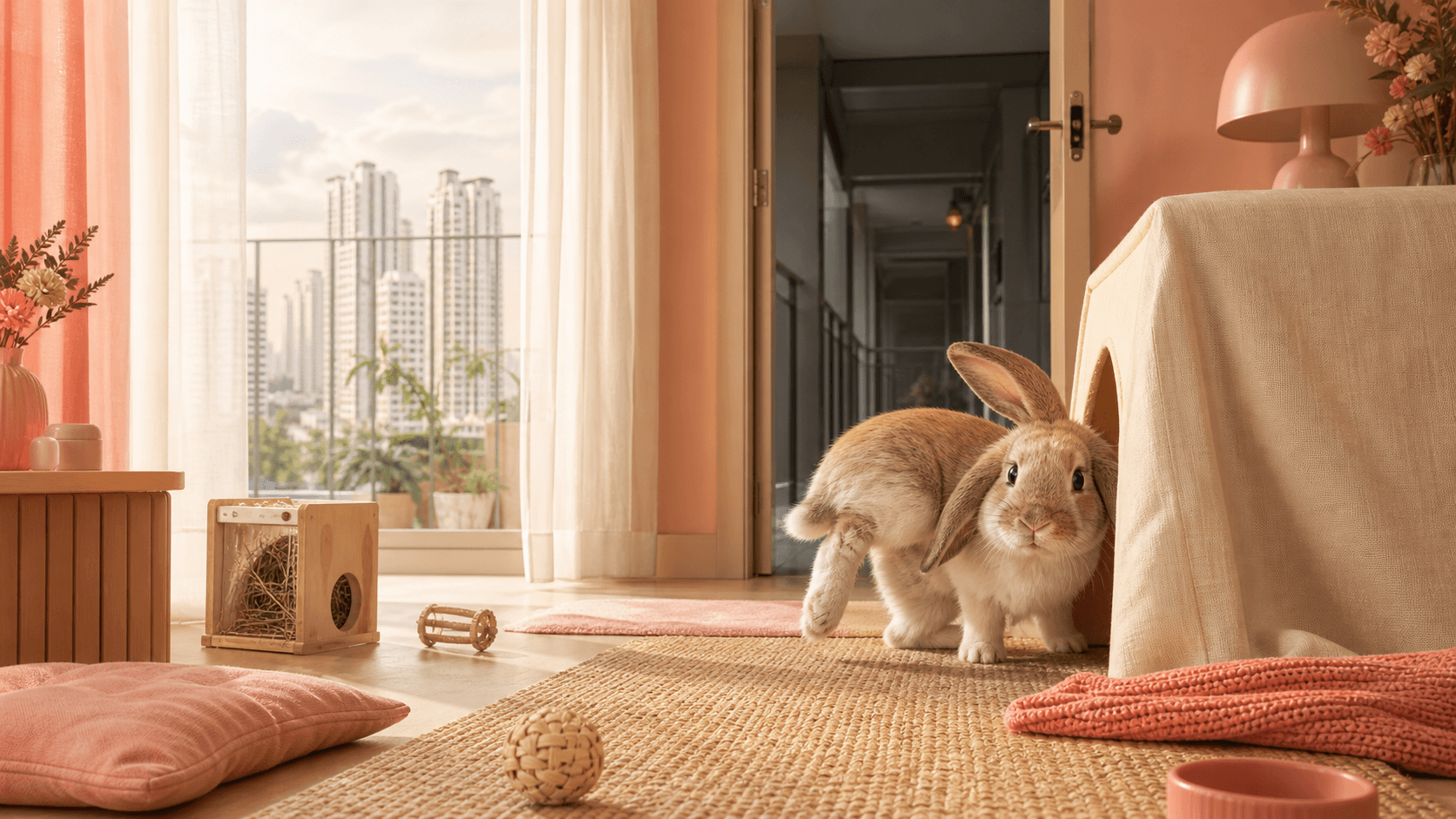
A rabbit that thumps once after corridor drilling may be saying, “I heard that.” A rabbit that thumps, hides, skips food, and leaves fewer droppings is saying something stronger.
Use this to prepare for the vet conversation, not to diagnose your rabbit at home.
Thumping is an alarm, not a personality flaw
A thump is normal rabbit communication. A rabbit stamps a hind foot to warn other rabbits, respond to fear, or react to something it reads as a threat, according to the Rabbit Welfare Association & Fund’s guide to rabbit body language and VCA’s overview of rabbit behaviour.
The owner job is not to stop every thump. The owner job is to read the whole picture.

Look at the trigger. Then look at recovery. A single thump after a door slam, visitor, dog smell, or unfamiliar noise can fit normal alarm behaviour. Repeated thumping with a tense body, flattened posture, hiding, reduced movement, or changed appetite deserves closer attention.
In a Singapore-style high-rise home, this matters. Rabbits may react to renovation drilling, corridor foot traffic, lifts, visitors, dogs, or balcony exposure. NParks/AVS frames rabbit care around suitable housing and welfare needs in Singapore, while HDB’s pet-keeping context reminds owners that many animals live close to neighbours, shared spaces, and daily building noise (NParks/AVS, HDB).
| What you see | Likely meaning | Owner action |
|---|---|---|
| One thump after a sudden sound | Alarm or fear response | Give quiet space and watch recovery |
| Thumping when handled | Fear, irritation, or discomfort | Stop rough handling and reassess |
| Thumping plus hiding | Stress, fear, or possible illness | Check food, droppings, posture, and breathing |
| Thumping plus reduced appetite | Possible health concern | Contact a rabbit-capable vet promptly |
Hiding is normal until the pattern changes
Rabbits are prey animals. Hiding is part of how they stay safe. A hideout is not a bad habit. It is furniture your rabbit understands.
The problem is change. The RSPCA notes that rabbits can hide signs of illness, so behaviour changes should be taken seriously. PDSA lists hiding, reduced appetite, hunched posture, teeth grinding, and unusual quietness among possible signs of pain in rabbits.
So do not ask, “Does my rabbit hide?” Ask, “Is this different from normal?”
A shy rabbit may retreat when visitors arrive, then come out for hay, water, grooming, or usual activity. A rabbit in pain may stay tucked away, sit hunched, grind teeth, avoid movement, or sit apart from a companion. Loud vocal signs are not the main thing to wait for. Rabbit pain can be quiet.
| Normal retreat | Concerning hiding |
|---|---|
| Hides after a noise, then returns to routine | Hides more than usual |
| Still eats hay or normal food | Refuses food or shows reduced interest |
| Produces normal droppings | Produces fewer or no droppings |
| Moves, grooms, and interacts later | Sits tense, hunched, or apart |
Food and droppings decide how fast you move
Appetite and droppings are the practical line. A rabbit that stops eating or produces fewer or no droppings needs urgent veterinary attention, because gastrointestinal stasis can become serious quickly. Cornell describes gastrointestinal stasis in rabbits as a serious condition linked to reduced appetite, reduced fecal output, and pain. MSD Veterinary Manual also notes that rabbit digestive disorders and abnormal feces can be clinically important.
This is where owners can be usefully boring. Check the same things every day: appetite, hay intake, water intake, droppings, urine, breathing effort, posture, movement, grooming, and interaction. House Rabbit Society encourages close monitoring of rabbit health signs, and the Royal Veterinary College highlights eating, droppings, mobility, and general demeanour as important changes to recognise in rabbit health.
Do not remove all hiding places to make the rabbit easier to watch. That can increase stress. The RSPCA recommends constant access to safe hiding places, exercise space, shelter, and rest areas, and Rabbit Welfare Association & Fund advises housing that lets rabbits run, jump, stretch, hide, and express natural behaviours (RSPCA environment guidance, RWAF housing guidance).

Heat, noise, and flooring can look like “bad behaviour”
In Singapore, Malaysia, and Indonesia, the home environment can be the trigger. Singapore’s Meteorological Service describes the local climate as warm and humid throughout the year, and that regional reality matters for rabbits indoors (Climate of Singapore).
Heat stress is not a behaviour problem. PDSA lists lethargy, panting or rapid breathing, drooling, weakness, and collapse as signs linked to heatstroke in rabbits. If those signs appear, treat it as urgent.
Other stressors are less dramatic but still real: sudden loud noises, unfamiliar smells, predator scent, rough handling, slippery flooring, lack of hiding places, and changes to territory. WabbitWiki and Woodgreen both link rabbit fear responses to context, handling, posture, hiding, thumping, and perceived threats (WabbitWiki, Woodgreen).
| Monitor | Call a rabbit-capable vet | Go urgently |
|---|---|---|
| One-off thump with quick return to routine | Hiding more than usual | Not eating |
| Brief hiding after noise | Reduced appetite | Fewer or no droppings |
| Startle after visitor or dog smell | Hunched posture or teeth grinding | Weakness or collapse |
| Dislikes slippery flooring | Reluctance to move | Panting, rapid breathing, or drooling in heat |
Plan the vet route before the emergency
Rabbit care needs a plan before the scary evening. Not every small-animal clinic is equally equipped for rabbit dentistry, imaging, or gastrointestinal emergencies. Owners in Malaysia and Indonesia can use professional veterinary bodies such as the Malaysia Veterinary Medical Association and PDHI as starting points for understanding local veterinary pathways.
At home, keep the routine simple. Give your rabbit secure hiding places. Keep the resting area quiet and shaded. Watch food and droppings every day. Notice whether thumping has a clear trigger and whether your rabbit recovers after it passes.
The small thing to do tonight: write down what your rabbit ate, what the droppings looked like, and what happened before the thump.
— Manja